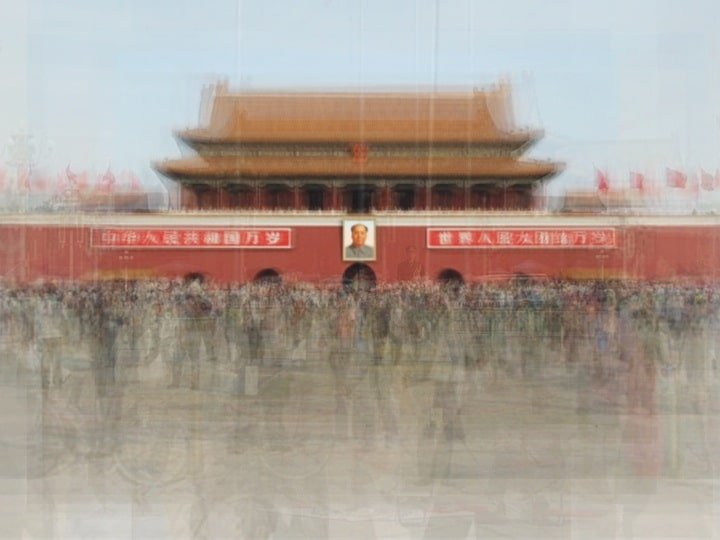
Hundreds of Tourist Photos Woven into One

Many photos of Tiananmen Square overlayed to impressive effect.

This is brilliant art–visually arresting while intellectually stimulating.

Switzerland-based Corinne Vionnet is our guide to the world’s most famous landmarks, monuments millions have visited before. Her art is created not by acrylic, oil, or watercolor, each piece is made by combining hundreds of tourist photos into one. After conducting an online keyword search and sifting through photo sharing sites, this Swiss/French artist carefully layers 200 to 300 photos on top of one another until she gets her desired result.

>> Hundreds of Tourist Photos Weaved into One (18 total) – My Modern Metropolis

Gorky Retrospective at MOCA

"Agony" by Arshile Gorky

For those of you in LA/visiting LA soon, I highly recommend checking out the Arshile Gorky retrospective at MOCA (the Los Angeles Museum of Contemporary Art).

The museum has put together a great collection of beautiful and compelling pieces. Until I visited, I’d only been roughly familiar with Gorky’s work–the color, the amorphous shapes, and haziness of form. But up close, there’s a depth to the paintings that you don’t appreciate from books and lithographs. The paintings are worth a trip to MOCA. Plus, you can check out many of MOCA’s pieces from their permanent collection which are on indefinite exhibition!

The Gorky retrospective exhibition runs through September 20th.

(FYI: Thursdays evenings from 5-8pm admission is free at MOCA!)

>> Link: Arshile Gorky: A Retrospective – MOCA

Wordle – word cloud art

Just tried this “cloud art” using Wordle–a self-proclamied “toy for generating ‘word clouds’ from text that you provide.”

You can pipe in your website URL, or paste in any text. Then you have a bunch of cool control over design, layout, color, and more. Here’s one of the pictures it made for SalvoLavis.com:

Nathan Sawaya: The Art of the Brick

Nathan Sawaya creates some amazing sculptures entirely from Legos.

Lego brick man

Check out his “Art of the Brick” Gallery for more cool pictures.

(Thanks to Andrew Sullivan’s blog for turning me on to this.)

Fleeting Youth, Fading Creativity in Science

In the Wall Street Journal, Johah Lehrer explores the connections between youth and creativity in the sciences.

For one, he notes the demographic shift toward older scientists:

In 1980, the largest share of grants from the National Institutes of Health (NIH) went to scientists in their late 30s. By 2006 the curve had been shifted sharply to the right, with the highest proportion of grants going to scientists in their late 40s. This shift came largely at the expense of America’s youngest scientists. In 1980, researchers between the ages of 31 and 33 received nearly 10% of all grants; by 2006 they accounted for approximately 1%. And the trend shows no signs of abating: In 2007, the most recent year available, there were more grants to 70-year-old researchers than there were to researchers under the age of 30.

Where are all the young people? It’s an important question.

But an equally important question–and one that I feel is relevant to proposing ways to change the status quo:

Why are young physicists and poets more creative? [Dean Simonton, a psychologist at the University of California, Davis] argues that they benefit, at least in part, from their willingness to embrace novelty and surprise. Because they haven’t become “encultured,” or weighted down with too much conventional wisdom, they’re more willing to rebel against the status quo. After a few years in the academy, however, “creators start to repeat themselves, so that it becomes more of the same-old, same-old,” Mr. Simonton says.

As we think about how to reinvigorate the sciences, I think it’s important to consider the effects of “enculturing” on a larger social level, too. We see it in middle school, high schools, and universities. Standardization of education may play a significant part in creating this perverse effect. So might our collective attitudes about what education means in this country.

But beyond the ivory tower, we see “enculturing” in the working world. Business leaders and entrepreneurs fight against this very thing. Though one might argue that every new gizmo on the market isn’t “moving the world forward” in the way scientific discovery does, there’s something about the spirit of innovation that thrives in market-driven endeavors.

What lessons can science learn from the world of entrepreneurship, and vice-versa?

Link: Fleeting Youth, Fading Creativity in Science [WSJ.com]

David Hockney | NYTimes.com

I love David Hockney’s work, especially his iconic photo collages like Pearblossom Highway. One of the best art exhibitions I ever saw was at MOCA years ago: a collection of many of Hockney’s original photo collages. They are huge, beautiful, full of energy, and awe inspiring. If you’re unfamiliar with his work, have a browse here.

David Hockney

For the interested, the NY Times covers David Hockney’s Long Road From Los Angeles to Yorkshire in today’s paper and online.

DEADLINE post-it stop motion

Awesome video of Post-It notes in stop motion:

(Thanks to Andrew Sullivan for the link)

Everybody Needs An Editer

Everybody Needs An Editer

Proudly powered by WordPress
Theme: Esquire by Matthew Buchanan.