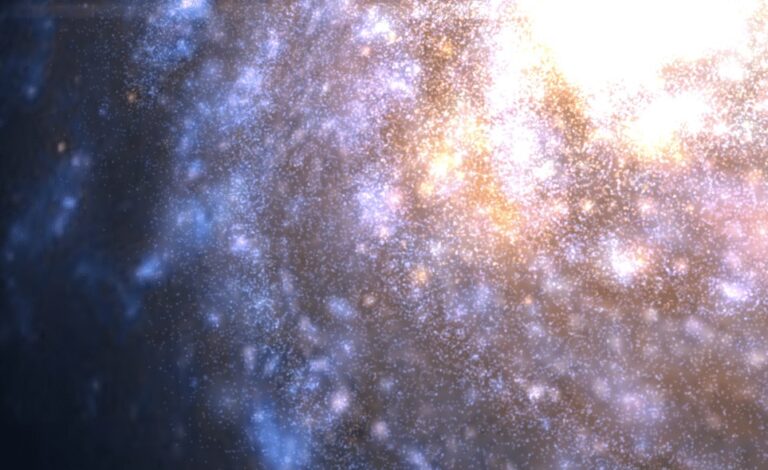
From the Google Chrome Experiments comes 100,000 Stars, a virtual tour of our Milky Way galaxy. This is one of the most awe-inspiring experiences I’ve ever had with a web browser. Go play and wonder.
>> 100,000 Stars | Chrome Experiments
From the Google Chrome Experiments comes 100,000 Stars, a virtual tour of our Milky Way galaxy. This is one of the most awe-inspiring experiences I’ve ever had with a web browser. Go play and wonder.
>> 100,000 Stars | Chrome Experiments
From the frontiers of astronomy, a galactic bird’s eye view of the universe:
Made up of more than 2.7 million images taken at four infrared wavelengths of light, the new image captures everything from nearby asteroids to distant galaxies.
I must admit, it’s easy to get turned around. I’m still looking for the little “I am here” marker.
>> Link: The Whole Universe In One Photo
SolarSystemScope presents a very cool online interface for zooming around the solar system in a beautiful 3D model. The whole experience happens right in your web browser. Check it out!
> Link: Solar System Scope | Interactive 3D model of Solar System Planets and Night Sky
The University of Arizona presents a well-produced series of engaging lectures on popular cosmology: the origins of the universe, black holes, dark matter, the big bang, and the search for (and understanding of) life in the universe. It’s all free on iTunes U–a fantastic source for free audio and video courses online.
If you’re wondering what this wide-angle view of the universe tells us…
Astronomers report that they’ve found a rocky planet with an atmosphere that could support life — and it’s orbiting a star only 20 light years from our Sun. (Apologies to any extra-terrestrial readers for my heliocentric slant.)
>> Link: Astronomers Find Most Earth-like Planet to Date | ScienceNOW
Type Ia Supernovae are a not just pretty in photographs. They play an important function in astronomy as a standard candle — a celestial object with known luminosity. By measuring visible brightness, astronomers can calculate a supernova’s distance.
In the LA Times today:
Type 1a supernovae are key to measuring celestial distances. Astronomers find evidence that they’re formed by the collision of two white dwarfs.
I was just watching a TV special on the Hubble Space Telescope, which has proved immensely useful to scientific research. Then started reading more about the next generation, the James Webb Space Telescope. Seems really cool. Fun if you’re into physics, astronomy, space, or just plain old discovery.
Proudly powered by WordPress
Theme: Esquire by Matthew Buchanan.